Is It Legal to Download From SoundCloud? The Honest Answer
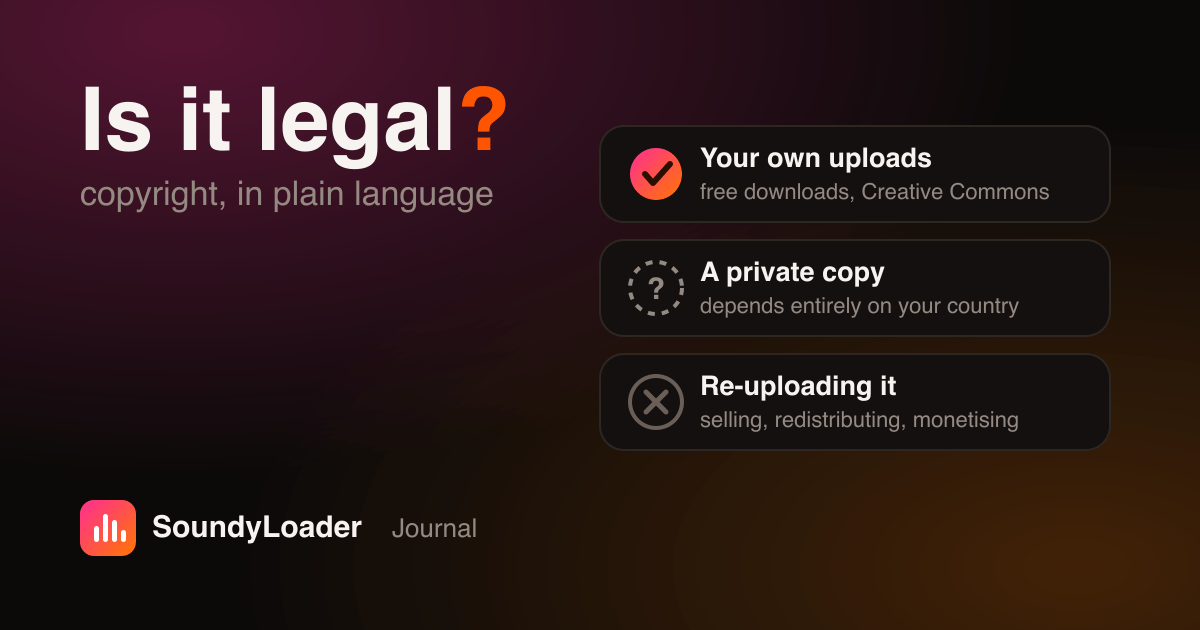
Search for a SoundCloud downloader and the legality question follows you around: forum threads, comment sections, and a lot of sites that either dodge it or pretend the answer is a simple yes. It isn't simple, but it is knowable. Whether downloading a SoundCloud track is legal comes down to three things — which track it is, what you do with the file, and which country you're in.
Here's the honest version, in plain language, without scaremongering and without telling you what you want to hear. This is general information rather than legal advice, and the note at the end means what it says.
The short answer
- Clearly fine — your own uploads, tracks where the artist switched on the download button, Creative Commons tracks used within their licence, and public domain material.
- Genuinely grey — a private copy of a public track for your own listening. Some countries permit this, some don't, and several changed their position in living memory.
- Clearly not fine — reuploading, selling, bundling a track into something you release, monetized video, or any commercial use without a licence.
Copyright, in one paragraph
Copyright gives whoever made a recording a set of exclusive rights: to copy it, to distribute copies, to make it available online, and to play it in public. A download is a copy — that's the whole legal question in one sentence. Streaming technically makes a copy too, but SoundCloud is licensed to serve it to you, so nobody argues about it. Saving the file creates a copy that needs its own permission, and permission comes from one of three places: the rights holder said yes, the licence on the track says yes (Creative Commons), or the law where you live carves out an exception.
The cases where downloading is clearly legal
- Your own uploads. You hold the rights. Pulling your own masters back off SoundCloud is nobody's business but yours.
- Artist-enabled free downloads. SoundCloud has a built-in download button uploaders can switch on. When it's on, the artist is handing you the file — plenty of them do it deliberately to spread their music.
- Creative Commons. A CC licence is standing permission. Read which one: BY means credit the artist, NC rules out commercial use, ND rules out edits and remixes, SA means derivatives go out under the same terms.
- Public domain. Recordings whose copyright has expired. Terms differ by country, so something in the public domain where you live may still be protected elsewhere.
- Direct permission. Asking an artist for a copy isn't a strange thing to do. Independent artists say yes more often than people expect.
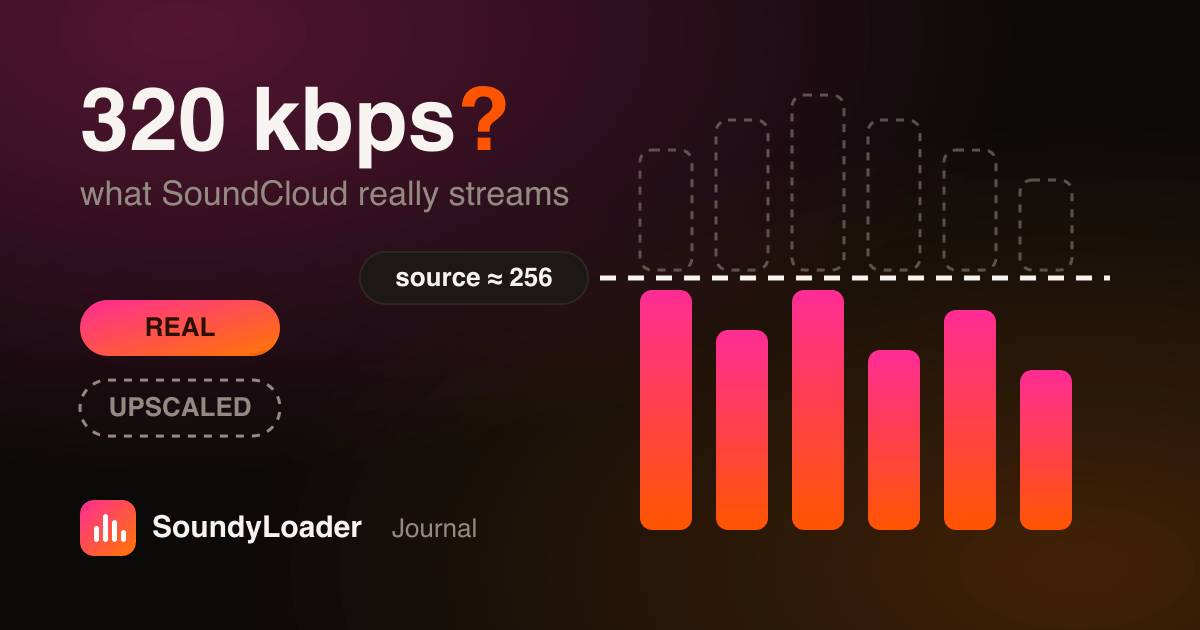
Those first two cover more of SoundCloud than people assume. A large share of the platform is independent artists who want their work spread, and many of them either flip the download toggle or publish under Creative Commons. If the built-in button is there, use it — it gives you the artist's original file, which is usually better than anything the stream carries. Our breakdown of what SoundCloud actually streams explains why that gap exists.
The grey area: private copies for yourself
This is the case most people are really asking about — a public track, saved for your own headphones, never shared with anyone. There is no single global answer here, and anyone who gives you one is guessing.
Some countries have a private copying exception written into their copyright law, historically funded by levies on blank media and storage devices. Germany is the textbook example: Section 53 of the UrhG permits copies for private use, but not from a source that is obviously unlawful, and not where you'd have to defeat a technical protection measure to get it. EU case law points the same way — the private copying exception doesn't stretch to copies made from an obviously infringing source.
Other countries are stricter than their reputation suggests. The UK introduced a private copying exception in 2014 and the High Court quashed it in 2015, which leaves even ripping your own CD to your own phone in an awkward position there. Japan runs harder in the other direction: downloading material you know to be infringing has been unlawful for music and video since 2010, criminal penalties followed, and the rule was widened to other copyrighted works in 2021 — so whether the upload was authorised matters enormously. The United States has no blanket private copying permission either. It has fair use, a four-factor test decided case by case, which is a defence rather than a rule you can lean on in advance.
The practical read: in most places, a personal copy of a track the artist posted themselves is low-risk and nobody is chasing it. A personal copy of a leak or an unauthorised re-upload is a different question in every country, and a worse one.
Where it clearly stops being okay
- Reuploading the file to YouTube, Spotify, another SoundCloud account, or a file-sharing site.
- Selling it, or putting it inside something you sell.
- Using it as background music in monetized video or advertising — that needs a sync licence.
- Sampling it into your own release without clearing the sample.
- Handing copies around a group — a Discord, a class, a mailing list — however friendly the intent.
DJing sits slightly apart, and the honest answer is that it's a licensing question rather than a downloading one. Venues and events generally hold public performance licences through the local collecting society — PRS, GEMA, ASCAP, JASRAC and their counterparts — which covers playing the music to a room. That says nothing about where your copy came from; some countries also have specific licences for a DJ copying tracks into a digital library. If you're being paid to play, source tracks legitimately: a promo pool, a purchase, or a file the artist gave you. One aside with nothing to do with the law: for a club USB stick, MP3 is the safe pick — rekordbox, Serato and Traktor read FLAC, but many Pioneer CDJs (CDJ-2000NXS and older) will not.
What SoundCloud's own Terms say
Separate from copyright, there's your agreement with SoundCloud. Its Terms of Use let you stream, and let you download where the uploader has enabled the download button. Beyond that, they prohibit copying, reproducing or redistributing content from the platform, and prohibit reaching the service through automated means or tools other than the official player and apps.
Worth being precise here, because the two get muddled constantly. Breaching a site's terms is a contract matter between you and that site — the realistic consequence is account action, not a courtroom. Copyright infringement is a matter between you and the rights holder, and it exists whether or not you ever clicked accept on anything. A Creative Commons track can be perfectly fine to copy under copyright law while SoundCloud would still rather you took it through their own button.
Is the downloader itself legal?
Tools are neutral, and that isn't a dodge — it's roughly how the law has treated general-purpose technology since the video recorder. A downloader resolves the same public stream your browser does and writes it to a file. One person saves their own upload, another saves something they have no right to, same button. Responsibility travels with the use, not the software.
Where neutrality would end is circumvention. Breaking DRM or a paywall is treated as its own offence in many places — the DMCA in the US, the InfoSoc Directive in the EU — quite apart from whether the copy infringes. SoundyLoader doesn't go near that. It doesn't decrypt DRM, doesn't unlock Go+ material, and can't reach private uploads, geo-restricted tracks, or anything that has been removed. What it does is convert a public stream to MP3, M4A or FLAC, tag it, and hand it to you.
A short checklist before you press download
- Is it your own upload? Go ahead.
- Does the track have SoundCloud's own download button? Use that one — it's the artist's file and the artist's permission.
- Is it Creative Commons? Check the variant and honour the credit, non-commercial and no-derivatives terms.
- Is the copy for you, or for an audience? Anything that leaves your own devices needs permission.
- Is money involved anywhere — a release, an ad, a paid gig? Then it's a licensing question, not a download question.
- Still unsure? Message the artist. It's the fastest route to a real answer.
This is not legal advice
We build a downloader, not a law firm. Nothing here is legal advice, copyright rules differ substantially between countries and change over time, and if real money or real risk is involved, talk to a lawyer in your own jurisdiction.
Where we stand: we'd rather set out the actual rules than pretend the question doesn't exist. Download your own work, take what artists have offered, respect Creative Commons terms, and think twice before a copy leaves your devices. If that's settled, the step-by-step guide covers the mechanics and the playlist downloader handles whole sets one track at a time.
Frequently asked questions
Is it legal to download from SoundCloud?
It depends on the track, what you do with it, and where you live. Your own uploads, artist-enabled downloads, Creative Commons tracks and public domain material are clearly fine. Redistribution, resale and commercial use clearly aren't. A private copy for personal listening is a grey area that differs by country.
Is using a SoundCloud downloader illegal?
The tool itself is neutral — it resolves the same public stream your browser does. Responsibility sits with the person using it and the specific track they save. What is treated as a separate offence in many countries is circumventing DRM or a paywall, which SoundyLoader does not do.
Is a SoundCloud downloader legal in Germany?
German copyright law includes a private copying exception (Section 53 UrhG), but it doesn't cover copies made from an obviously unlawful source and doesn't permit defeating technical protection measures. Saving a track an artist uploaded and offered themselves is a very different case from copying an unauthorised re-upload.
Is downloading music from SoundCloud illegal in Japan?
Japan is stricter than most. Downloading material you know to be infringing has been unlawful for music and video since 2010, with criminal penalties added afterwards, and the rule was extended to other copyrighted works in 2021. Whether the upload was authorised matters a great deal there.
Does downloading break SoundCloud's Terms of Use?
SoundCloud's terms allow streaming and allow downloads where the uploader enabled the download button; outside that they prohibit copying content and using non-official tools to access the service. That's a contract question between you and SoundCloud — realistically an account matter — and separate from copyright.
Is it legal to download Creative Commons tracks from SoundCloud?
Yes, within the licence terms. Check which variant applies: BY requires credit, NC rules out commercial use, ND rules out edits and remixes, and SA requires derivatives to be shared under the same licence.
Can I play downloaded SoundCloud tracks in my DJ sets?
Public performance is normally covered by the venue's licence with the local collecting society, but that says nothing about where your copy came from. If you're being paid to play, source tracks from a promo pool, a purchase, or directly from the artist.
Can I get in trouble for downloading one song for myself?
Enforcement realistically targets distribution and commercial use rather than one person keeping a private copy. That isn't the same as saying a private copy is legal everywhere — in several countries it isn't — but the risk profile is nothing like uploading or selling.